Showing posts with label recycling. Show all posts

Saturday, November 14, 2009

Brooklyn Bridge Park Makes Recycling a Priority

Although only a tiny fraction of Big Apple parks recycle, a new one now under construction along the Brooklyn waterfront is set to take being green to another level.

The planned 85-acre Brooklyn Bridge Park, which is set to partially open this winter after two decades of planning, is being partially built with recycled materials. This includes scraps from former pier sheds that were torn down to make way for the park.

The park will also feature an irrigation system relying on recycled rainwater and an on-site recycling system for its waste. . .

Learn More at NYPost.

Learn More about the Park.

Tuesday, May 27, 2008

Bagging the Brita

You've swapped your gallon water jug bottles for the reusable Brita Filter. Now What? How do you get rid of your filters? Currently there is no way to refill or recycle Brita filter cartridges in North America. There may be a solution in the future...

Take Back The Filter is a campaign to ask Clorox (owner of Brita) to come up with a sustainable solution for the tons and tons of filters we go through each year. Visit their site, takebackthefilter.org and take these actions: send them your filters! sign the petition, write a letter, and spread the word.

What a great thing the power of suggestion is.

Monday, March 31, 2008

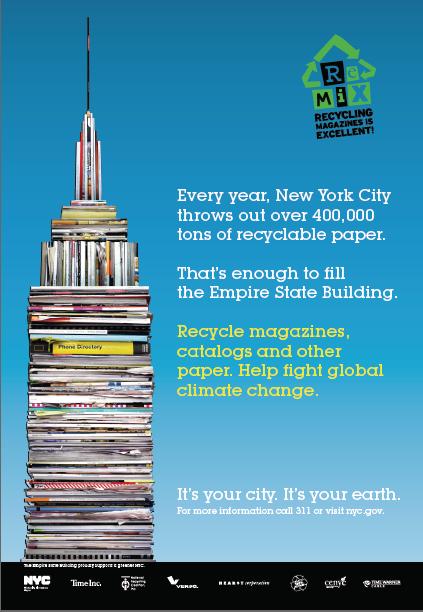
NYC Launches Re-Mix Campaign

Mayor Bloomberg Launches REMIX: Recycling Magazines is Excellent!

Mayor Michael R. Bloomberg today announced the New York City launch of ReMix - Recycling Magazines is Excellent! - a national public education campaign aimed at increasing residential recycling of magazines and catalogs.
ReMix promotions will appear across New York City, in full-page public service advertisements in consumer magazines including TIME, Cosmopolitan, Country Living and Sports Illustrated as well as on buses and subways, in movie theatres, on cable television, and in other outlets. The total value of paid placements and in-kind donations for the ReMix campaign will top $3 million. The ReMix national campaign was started by Time Inc., with partners Verso Paper and the National Recycling Coalition.
"To meet the ambitious goals in our landmark Solid Waste Management Plan (SWMP), we need to increase recycling rates, and we know we can do a better job recycling magazines and catalogs," said Mayor Bloomberg. "Many New Yorkers don't realize that magazines, catalogs, phone books, and other kinds of paper are just as recyclable as newspapers and office paper. I'd like to thank our ReMix campaign partners for doing their part to increase magazine and catalog recycling and for joining our effort to build a greener, greater New York."The ReMix campaign began when a study by Time Inc. and Verso Paper found that while 95 percent of all unsold newsstand magazines are recycled by newsstands and publishers, only about 17 percent of sold magazines are recycled.
"Our national research showed that Americans support recycling, but are often uncertain about what can be recycled," said National Recycling Coalition Executive Director Kate Krebs. "We know that New Yorkers have embraced recycling as a way to keep waste out of landfills and improve the environment. Today, the Mayor and City officials, leading companies and advocacy organizations are launching ReMix in New York City to make sure everyone knows just how easy it is to recycle magazines and catalogs right along with their other paper recycling."
Partners:
Time Inc.
Verso Paper
National Recycling Coalition
Hearst Corporation
Pratt Industries
Time Warner Cable
The Council on the Environment of New York City

Monday, March 10, 2008

Electronics Recyling in NYC - What's That About?

As the fate of a City Council bill requiring electronic waste recycling rests on the tip of Mayor Michael R. Bloomberg’s pen, many New Yorkers have no idea where and how to dispose of unwanted electronic items, many of which contain environmental hazards like lead and mercury.
Sabrina Brown, for example, has never heard of “e-waste” recycling.
Ms. Brown, 20, a student from Richmond Hill, Queens, said she had three cellphones, an old laptop computer, an old television, two old radios and three old cameras sitting in her room.
“I don’t know where to take them,” she said.

Mr. Bloomberg has expressed strong opposition to a bill passed by the City Council last month that would fine New Yorkers $100 for throwing electronics in the garbage and would require manufacturers to take back their products and those made by companies that are no longer in business.

The Lower East Side Ecology Center, a nonprofit environmental group, holds monthly electronic waste drop-off events. The center also works with Build It Green! NYC, a nonprofit retail outlet for salvaged and surplus building materials, which accepts unwanted electronics at its warehouse in Astoria, Queens, Tuesdays through Saturdays.

Per Scholas is a Bronx-based organization that accepts old electronics and refurbishes computers to distribute in low-income communities and to schools. Some retailers, including Staples, accept old electronics at their stores for recycling.

Last year, the Lower East Side Ecology Center collected 118 tons of discarded electronics, more than in any previous year, though the center also held twice as many collection events as it had in the past.

The Sanitation Department, which began its electronics drop-off events in 2004, saw a steady increase in its collection through the first three years. But the number of tons collected dipped to 295 in 2007 from 309 in 2006, though the number of people who provided something for recycling increased. According to a Sanitation Department study of waste disposed in 2004 and 2005, discarded electronics made up 0.64 percent of the city’s trash. But even a small amount of such waste can produce contamination, said Kate Sinding, a senior attorney with the Natural Resources Defense Council.

Carey Pulverman, the project manager for the Lower East Side Ecology Center, spends much of her day on the phone with people looking for ways to get rid of old electronics. “The thing is, people don’t want to go out of their way to do it,” she said. “Mostly, it’s them trying to talk to me about why they need their stuff picked up.”

Full Story, NYTimes

Friday, March 7, 2008

Bag-less in Dumbo

Two businesses in DUMBO have begun weaning customers off the latest symbol of wasteful consumerism: the plastic shopping bag. Foragers, the high-end grocery store at Front and Adams streets, has begun deducting 10 cents from the purchases of patrons who decline plastic bags. And Water Street Restaurant and Lounge has stopped delivering food in plastic bags. “We really want our store to be as garbage-free as possible,” said Anna Castellani, the store’s owner (pictured). Castellani said she been trying to cure Brooklynites of their plastic addiction since opening her store two-and-a-half years ago, but said that only recently have customers become amenable to the idea.

In January, the City Council joined the worldwide trend, passing a law requiring stores with at least 5,000 square feet, or chain stores with five or more branches in the city, to collect plastic bags for recycling. The goal of the bill, which goes into effect in July, is to save a tiny bit of the 12 million barrels of oil that are converted into plastic bags every year.


Jane Kojima, a spokeswoman for the DUMBO Improvement District, said she’s lined up about 20 businesses that will begin reducing plastic bags starting in March, once the group distributes canvas bags to every household in the neighborhood. As usual, the Park Slope Food Co-op, which charges members for plastic bags on the honor system, is way ahead of the green movement — though not as far ahead as its general manager would like. “This spring, the Co-op plans to up the ante, voting to entirely eliminate all disposable bags — plastic and paper — from the cooperative grocery store. Holtz predicted that the measure would pass.

Castellani said her three-week-old initiative appears to be having some effect. About 50 percent of her customers now decline plastic bags. Corey Szopinski, who frequently fills up his stomach — and a biodegradable container — with Foragers’ sublime mac and cheese, said he’s thrilled with the new initiative. “Business owners need to start thinking about reducing waste,” said Szopinski. “[And] now that they have biodegradable containers and potato starch utensils (which are awesome!), I go there instead of to restaurants that use Styrofoam or plastic.”
Also, staff from the Center for the Urban Environment have launched a month-long No Plastic Bag Challenge. The goal is to reduce plastic bag use by 75%

Saturday, February 23, 2008

Putting Your Cork to Good Use

Cork is obtained from the bark of the Cork Oak Tree - Quercus suber. Over 50% of the world's cork supply comes from Portugal. Cork is one of the few forms of packaging that is environmentally friendly! Harvesting of the cork tree is first done when the tree is 25 years old, and then can only be stripped once every nine years. And the 3 harvesting is the only harvest that is smooth and natural enough for manufacturing of Wine Corks.

Since it takes so long for a cork oak tree to yield it's first cork. It's dis-hearting that we turn around and throw it away. Why not recycle this natural object and allow the cork to be recycled into other products

Recycle Cork USA, LLC has launched a nonprofit called Kork 4 Kids, which raises funds from the recycling of cork for Children's Charities.

Here's what you do:
1. Start collecting your corks today, in a drawer or bag.

2. Once you have a sizable amount. Send your corks (via flat rate shipping) to :Korks 4 Kids Programc/o RECYCLE CORK USA, LLC.510 Wynwood RoadYork, Pennsylvania 174023. Hold on to your receipt for charitable contribution.

Closing the loop, one bottle at a time.

Thursday, February 14, 2008

Electronics Recycling Bill

The Big Apple is a step closer to adopting one of the toughest electronics recycling laws in the nation. The City Council approved a bill that would impose a $100 fine on anyone who throws an old computer, printer or other electronic gadget into the trash. Recycling the electronic waste will become mandatory, and manufacturers will be required to take back their own products as well as those made by companies that have gone out of business. The Council estimated that New Yorkers purchase more than 90,000 tons of electronic products every year. The gadgets contain hazards like lead and mercury, and most end up in the trash. If the new measure becomes law, the city’s voluntary electronics collection and recycling programs would be replaced by a variety of programs designed and run by Sony, Dell and other electronics manufacturers. Those efforts could include curbside pickups, returns by mail and in stores, and neighborhood collections.

NYC would become the first major city in the nation with an electronics recycling law that takes aim at producers. Ten states, including Connecticut and New Jersey, have already adopted similar measures. (New Jersey’s law is not yet in effect.)

Under the proposed law, manufacturers would start collecting electronics for recycling in 2009. Starting in 2010, city residents could be fined $100 if they threw out a piece of electronic equipment. In 2012, manufacturers would have to collect enough discarded electronic equipment to equal 25 percent of the average weight of the goods they sold in the city during the previous three years.

During the first 2 years, manufacturers would only have to accept their own products. But starting in 2011, they would be required to take products from any manufacturer, or face a $2,000 fine for each item they refused to take. For this reason, the mayor is hesitant. “The administration supports ‘e-recycling,’ but the current bill has untested and arbitrary industry performance standards, which we will not support,” said John Gallagher, a spokesman for Mr. Bloomberg, who was traveling. “These standards penalize manufacturers for the actions of customers, which we believe is unconstitutional.”

The mayor was expected to veto the measure, which passed 47-3, but the strong level of support in the Council could lead to an override or to concessions from both sides.

To learn more, go to NYTimes

STAY TUNED...

Wednesday, February 13, 2008

Back To The 3 R's

In NRDC's latest e-newsletter, This Green Life, they talk about the 3 r's. It's certainly worth reading. Here are some excerpts:

Consumer product companies are always selling us a new bill of goods. The latest is that we can shop our way to a healthier planet. Over the years, they've also told us that cool cars would make us free and diet soda would make us popular. But there are some things money -- and advertising -- can't buy, and a clean environment is one of them.

It takes resources to manufacture and transport all products, even those made from recycled content. At the very least, energy is spent. And spending resources leaves the world poorer, not better off. Buying nothing is better for the earth than buying green. More often, though, it is greener to follow the old dictum: reduce, reuse, recycle.

Reduce. "Reduce" means using fewer resources in the first place. This is the most effective of the three R's and the place to begin. It is also, I think, the hardest because it requires letting go of some very American notions, including: the bigger the better, new trumps old and convenience is next to godliness. But you don't need to let go completely or all at once. "Reduce" is a comparative word. It says: cut back from where you are now. When you shop, shop differently. Look for things that will last -- things that are not just durable and well-made, but useful and beautiful enough to please you for a long time. Then, maintain it accordingly and repair it when necessary.

Reuse. Before you recycle or dispose of anything, consider whether it has life left in it. A jam jar can store leftovers. Food scraps can become compost. An old shirt can become a pajama top. An opened envelope can become a shopping list. A magazine can be shared. DVDs can be traded. A dishwasher can be repaired. A computer can be upgraded. A car can be resold. A cell phone can be donated. Returnable bottles can be, well... returned. Reusing keeps new resources from being used for a while longer, and old resources from entering the waste stream. It's as important as it is unglamorous. Think about how you can do it more.

Recycle. Recycling is the "R" that has caught on the best. Partly, this is because there are so many curbside recycling programs today (8,660 as of 2006, according to the EPA), which makes recycling easy. Everyplace has rules. Most only take packaging made from #1 (PET or PETE) and #2 (HDPE) resins. You need to look at the bottom of the package for the chasing arrow symbol and check that the number is right. New York City, for instance, accepts #1 and #2 containers with necks, but not wide mouths because the two are formed differently and have different melting points. The wrong kind of plastic can "contaminate" the whole batch, rendering it garbage as far as the company with the recycling contract is concerned.

—Sheryl Eisenberg, NRDC's This Green Life

Thursday, January 3, 2008

RECYCLE YOUR ELECTRONICS/CLOTHING

MANHATTAN: Sunday January 6, 2008, from 10am - 4pm Union Square Park - North Plaza Broadway & E 17th Street
MORE INFO: www.lesecologycenter.org*

BROOKLYN: Saturday, January 5th and Sunday, January 6th from 1pm until 5pm462 Marlborough Road (between Ditmas and Dorchester), Flatbush

MORE INFO: http://sustainableflatbush.org/?p=273

RECYCLE YOUR TEXTILES: The Material Mondays pilot program at Union Square ended December 31, 2007 to make way for park renovations, but the textile recycling continues at Grand Army Plaza in Brooklyn! Visit us at Second Chance Saturdays, Grand Army Plaza Greenmarket, NW Entrance to Prospect Park Saturdays from 8pm – 4pm from January 5 through March 29, 2008.

Source: Council on the Environment of NYC

Tuesday, December 18, 2007

Tracing Your Trash

“…We don’t need a better way to get rid of things. We need to not get rid of things, either by keeping them cycling through the system—or by not designing and desiring them in the first place.”

On the whole, a little more than half of America’s household garbage goes to landfills. The rest goes to incinerators, recycling centers, or composting facilities.

While garbage pickup is generally organized by the local government, it changes hands at a transfer station and becomes the responsibility of private haulers, who are paid by the ton to take it away. Transfer stations are large warehouses where tons of garbage are dumped by collection trucks and repacked into trucks, barges, and rail cars for their journey to the landfill or incinerator. The garbage thrown away by city dwellers may travel to a distant landfill several states away—many solid waste companies have paid rural towns to landfill garbage from larger urban areas.At every step, trash headed for the landfill takes a toll on the environment. There is pollution generated by the fleets of diesel-powered trucks that transport it, and landfill gas, methane and carbon dioxide, and fluid that drains from the garbage. This liquid, known as leachate, is a toxic “juice” of the chemicals that erode off of electronics, pet waste, nail polish remover, food waste, cleaning products, batteries, and more.

Incineration- Despite the pollution and lack of popularity for incineration, 13 percent of America’s garbage is still burned. Modern-day incinerators are enormous columns the size of an office building, where thousands of tons of garbage a day burn at 3,000°F temperatures. Despite pollution controls, which recover some energy from the process, burning plastic still produces carcinogenic dioxin and leaves behind ash laced with heavy metals.

Recycling-There are 9,000 curbside recycling programs across the country, a growing number of which are “single stream” programs in which residents place empty glass bottles, aluminum cans, and plastic containers together in their bins. Bins are collected, and brought to a Materials Recovery Facility (MRF) where creative mechanical processes like blasts of air and magnetized devices sort recyclables. Teams of workers do the remaining sorting manually.
Some materials are truly recyclable over the long-term, while others can only be diverted from the landfill once or twice. Glass and aluminum are perpetually recyclable, while paper can be “downcycled” several times into lower-grade products. Plastics can usually only be “downcycled” once into a different material that is not itself recyclable.

The markets for various materials fluctuate, and MRFs end up landfilling or incinerating some “residuals”—a share of whatever they collect that cannot by recycled or sold for recycling (some mixed plastics are sent to developing countries, especially in Asia, where they may be recycled, but are often burned or dumped unsafely.) For just about all materials, recycling waste into a new product saves significant energy over creating the material from scratch. 79 percent of all aluminum, 78 percent of glass, half of the paper, and 95 percent of plastic in household garbage was going out with regular trash, instead of being put into a recycling bin, according to the EPA in 2005.

“Garbage should worry us,” writes Elizabeth Royte in Garbage Land: On the Secret Trail of Trash (Back Bay Books, 2006). “…We don’t need a better way to get rid of things. We need to not get rid of things, either by keeping them cycling through the system—or by not designing and desiring them in the first place.” –AMEN

There’s always composting!

Source: Joelle Novey, Co-op America